Alright, breaking with form, but: you have to read
Kate Beaton.
This is IT. This is the serious shit. I've been reading this for hours. Here will be the one link, so this doesn't look like one of my one-sided gmail conversations where I send 150 links to three friends while they secretly plot to kill me by cutting my name out of Reply to All. (that's not how they plan to kill me, that's how they ... make plans to kill me).
But let it be known, Kate Beaton's also written a million other (yes, a million) a million other awesomazing cartoons about mermaids, and sailors. also: History, Canada, cats. seen some cats in the piece. Pope JP, Deux, greatest Pope ever. (I'm Catholic, it's true). Literature.
Man. phew. This is it.
Showing posts with label sailors. Show all posts
Showing posts with label sailors. Show all posts
Friday, September 25, 2009

Thursday, September 17, 2009
Under Pressure
Mermaids, it is quite clear, have evolved a pretty fantastic* respiratory mechanism. We know they can breathe air and water without issue. Is it gills? Is it magic? Is it a product of mermaid science that seems like magic? Scientifically plausible mermaids, if I had to guess, would be grotesque, barrel-chested creatures with webbed appendages, very few recognizable sensory features on their heads (as compared to human beings, that is), and saw-toothed rows of gnashing teeth.† Plausible by surface-science, mind you – mermaid science is very different.
And by mermaid science there's no real explanation as to why they can breathe both air and water, because mermaids study ... well, they do study biology, but mostly in the categorical sense. Mermaids have a deep and abiding love for taxonomy. However, they have very different names for everything under the sea. It wouldn't be hard to name things differently from human beings – we tend to name things after ourselves. Mermaids have this habit, too, but they usually forget and rename those things until arriving at a suitably descriptive moniker that any mermaid would arrive at after sufficient reflection. Plus everything they name is in the mermaid equivalent scientifically bastardized Greek or Latin, and you don't need me to tell you how many levels of incomprehensibility that has even for mermaids.‡
Now, back to the matter at hand – one of the heretofore unnoticed marvels of the mermaid sociopulmonary system is that mermaids can rapidly adapt to pressure variations without suffering adverse affects such as human beings do. The bends, for example, aren't a big problem for mermaids. They race up and down the water column – to harass sailors, chase squid, who knows – and they don't have to worry about taking it easy like SCUBA divers other landed seafarers.
It is important to note, however, that this is a feature of the mermaid's aforementioned sociopulmonary system. By some fatal quirk of evolution, whatever it is that makes mermaids such resilient breathers is intimately connected to their neural passages. It's not to say they're sensitive – quite the opposite, in fact, they have very robust egos – but more that they're inattentive. The ability to adapt to rapidly changing environments (be they social or physical), predisposes the mermaid to immerse him or herself in rapidly changing environments. Mermaids get bored easily, so they go off and harass sailors.
Resilient though they are, if a mermaid is particularly overwhelmed, they have panic attacks and hyperventilate. It's much more common than in human beings, since our sociopulmonary systems aren't as well developed. It's even widespread in some populations of mermaid. These groups resemble myotonic goats, inasmuch as the condition is nonlethal, but hilarious.
High school, due to these highly advanced sociopulmonary systems, is more boring than it is difficult for the mermaid teenager. As they can resist high levels of pressure, most activities are engaged in entirely of the mermaid's own volition, and there are very low levels of crushing, burdenous angst. Merteachers have instituted several periods of daily recess through all levels of education, as much for themselves as the students – even in the great schools of higher mer-learning, biologians and thermodynamiticians still have recess when they're at the lab. Otherwise everyone would go nuts.
This accounts for many research stations being located in those rare spots where one can find both lots of dolphins and lots of sailors. You'd think mermaids would make fun of nerds, but since they all have such high self-esteem it doesn't really work. Octopus, on the other hand, are very easy to make fun of, so Tom Armalast** is easily the angriest and most ridiculed guy at the lab, even if he is really smart. He'd quit, but you just don't find the same opportunities back in octopus society. Octopus are cutthroat.

* I'm so awesome.
† Okay, maybe not the teeth.
‡ One of those languages is called Bloop, I think. Or well – Ancient Bloop. Spoken by the long-dead Bloops, Ancient Bloop bears little resemblance to Modern Bloop, except that they share a certain number of cases and tones you don't find in contemporary languages (Gurple, for example).
** No one bothered to learn his Octopus name; they would have made fun of it anyway.
And by mermaid science there's no real explanation as to why they can breathe both air and water, because mermaids study ... well, they do study biology, but mostly in the categorical sense. Mermaids have a deep and abiding love for taxonomy. However, they have very different names for everything under the sea. It wouldn't be hard to name things differently from human beings – we tend to name things after ourselves. Mermaids have this habit, too, but they usually forget and rename those things until arriving at a suitably descriptive moniker that any mermaid would arrive at after sufficient reflection. Plus everything they name is in the mermaid equivalent scientifically bastardized Greek or Latin, and you don't need me to tell you how many levels of incomprehensibility that has even for mermaids.‡
Now, back to the matter at hand – one of the heretofore unnoticed marvels of the mermaid sociopulmonary system is that mermaids can rapidly adapt to pressure variations without suffering adverse affects such as human beings do. The bends, for example, aren't a big problem for mermaids. They race up and down the water column – to harass sailors, chase squid, who knows – and they don't have to worry about taking it easy like SCUBA divers other landed seafarers.
It is important to note, however, that this is a feature of the mermaid's aforementioned sociopulmonary system. By some fatal quirk of evolution, whatever it is that makes mermaids such resilient breathers is intimately connected to their neural passages. It's not to say they're sensitive – quite the opposite, in fact, they have very robust egos – but more that they're inattentive. The ability to adapt to rapidly changing environments (be they social or physical), predisposes the mermaid to immerse him or herself in rapidly changing environments. Mermaids get bored easily, so they go off and harass sailors.
Resilient though they are, if a mermaid is particularly overwhelmed, they have panic attacks and hyperventilate. It's much more common than in human beings, since our sociopulmonary systems aren't as well developed. It's even widespread in some populations of mermaid. These groups resemble myotonic goats, inasmuch as the condition is nonlethal, but hilarious.
High school, due to these highly advanced sociopulmonary systems, is more boring than it is difficult for the mermaid teenager. As they can resist high levels of pressure, most activities are engaged in entirely of the mermaid's own volition, and there are very low levels of crushing, burdenous angst. Merteachers have instituted several periods of daily recess through all levels of education, as much for themselves as the students – even in the great schools of higher mer-learning, biologians and thermodynamiticians still have recess when they're at the lab. Otherwise everyone would go nuts.
This accounts for many research stations being located in those rare spots where one can find both lots of dolphins and lots of sailors. You'd think mermaids would make fun of nerds, but since they all have such high self-esteem it doesn't really work. Octopus, on the other hand, are very easy to make fun of, so Tom Armalast** is easily the angriest and most ridiculed guy at the lab, even if he is really smart. He'd quit, but you just don't find the same opportunities back in octopus society. Octopus are cutthroat.

* I'm so awesome.
† Okay, maybe not the teeth.
‡ One of those languages is called Bloop, I think. Or well – Ancient Bloop. Spoken by the long-dead Bloops, Ancient Bloop bears little resemblance to Modern Bloop, except that they share a certain number of cases and tones you don't find in contemporary languages (Gurple, for example).
** No one bothered to learn his Octopus name; they would have made fun of it anyway.
Thursday, August 20, 2009
Anatomy and Physiology
It's time to return to the question that gave rise to this project:
How do mermaids do drugs?
Mermaids are pretty laid back, it's clear that they're not into speed or anything; but the question isn't what drugs they do, it's how they do them. Regardless of your moral-ethical stance on drugs (it's ethical for mermaids, you'll see), it's a fact of mermaid society – they don't really have any responsibilities other than to harass sailors (it turns out that's actually their job, like Sirens and Harpies), so mermaids have a lot of free time.
Mermaids can't always go up to bask on rocks and smoke marijuana, because mermaid kings are always issuing jealous and frustrated edicts prohibiting mermaid presence on basking rocks. While generally ignored, there are still plenty of mermaids that don't want to provoke the wrath of the deprived merking. Even if they're not harassing sailors, which is all merkings really want to do, they might get a trident in the eye.
So right, so mermaids need drug alternatives. We can deduce without scientific study that they have a different metabolism than we do. To start, if they live above and below water then clearly their cardiovascular system is amphibious and they don't process oxygen the way we do (take also into account deep-sea mermaids, who exist in oxygen poor environments and must be even more dissimilar to us). Mermaids also need to regulate salinity in their system very differently, since they live in salt water. This makes me wonder how they get their iodine, since they never salt anything. But I digress – we see references in the anatomical writings of Ibn al-Nafis and Mansur ibn Ilyas:
Now, I'm not going to venture a guess as to whether mermaid bodies are full of seaweed or not (not unlikely though; I mean, if they're made of foam, why not?), but the evidence seems to indicate, irrefutably, that mermaids get high by provoking poisonous fish to sting them.
Much in the same way that human beings sometimes enjoy exposing themselves to the capsaicin in hot peppers, mermaids have grown fond of fish poisons. Stonefish, Blowfish, Lionfish, all are examples of popular intoxicant fishes. Because mermaid bodies metabolize other stuff differently, fish poisons don't kill them the way they kill us.*
Really it's just practice – if they're confined to the watery deep by merking decree, mermaids have to provoke something other than sailors. It's in their nature, they can't help it. So they're not drug addicts or anything; the behavior leading to drug use in mermaids is habitual, not the use of drugs itself.
Mer ministers, viziers, and PETA types object to fish harassment, and this is promoted by ruthless merkings that seek naught but the frustration of their people, that they suffer as their king. Wiser, more forgiving merkings keep fish-harassing restrictions to a minimum, because if mermaids can't harass anything they write petitions to the king and that's annoying. All merkings generally promote the harassment of mermaids by fish-headed mermaids.

* Wikipedia: The large amount needed to kill an adult human and the low concentration of capsaicin in chilies make the risk of accidental poisoning by chili consumption negligible.
same article: Tarantula venom activates the same pathway of pain as is activated by capsaicin.
How do mermaids do drugs?
Mermaids are pretty laid back, it's clear that they're not into speed or anything; but the question isn't what drugs they do, it's how they do them. Regardless of your moral-ethical stance on drugs (it's ethical for mermaids, you'll see), it's a fact of mermaid society – they don't really have any responsibilities other than to harass sailors (it turns out that's actually their job, like Sirens and Harpies), so mermaids have a lot of free time.
Mermaids can't always go up to bask on rocks and smoke marijuana, because mermaid kings are always issuing jealous and frustrated edicts prohibiting mermaid presence on basking rocks. While generally ignored, there are still plenty of mermaids that don't want to provoke the wrath of the deprived merking. Even if they're not harassing sailors, which is all merkings really want to do, they might get a trident in the eye.
So right, so mermaids need drug alternatives. We can deduce without scientific study that they have a different metabolism than we do. To start, if they live above and below water then clearly their cardiovascular system is amphibious and they don't process oxygen the way we do (take also into account deep-sea mermaids, who exist in oxygen poor environments and must be even more dissimilar to us). Mermaids also need to regulate salinity in their system very differently, since they live in salt water. This makes me wonder how they get their iodine, since they never salt anything. But I digress – we see references in the anatomical writings of Ibn al-Nafis and Mansur ibn Ilyas:
Adaptations both cardiovascular and pertaining to the homeostatic regulation of salinity in the mermaid body indicate that the merorganism behaves differently from that of Homo sapiens with regards to chemical substances.There are mermaid texts, furthermore, outlining these differences, as seen here in a 15th century work translated by ibn Ilyas. It is evident from the picture that mermaids fail to understand the inner workings of the human body, as they've chosen to depict it full of seaweed.
Now, I'm not going to venture a guess as to whether mermaid bodies are full of seaweed or not (not unlikely though; I mean, if they're made of foam, why not?), but the evidence seems to indicate, irrefutably, that mermaids get high by provoking poisonous fish to sting them.
Much in the same way that human beings sometimes enjoy exposing themselves to the capsaicin in hot peppers, mermaids have grown fond of fish poisons. Stonefish, Blowfish, Lionfish, all are examples of popular intoxicant fishes. Because mermaid bodies metabolize other stuff differently, fish poisons don't kill them the way they kill us.*
Really it's just practice – if they're confined to the watery deep by merking decree, mermaids have to provoke something other than sailors. It's in their nature, they can't help it. So they're not drug addicts or anything; the behavior leading to drug use in mermaids is habitual, not the use of drugs itself.
Mer ministers, viziers, and PETA types object to fish harassment, and this is promoted by ruthless merkings that seek naught but the frustration of their people, that they suffer as their king. Wiser, more forgiving merkings keep fish-harassing restrictions to a minimum, because if mermaids can't harass anything they write petitions to the king and that's annoying. All merkings generally promote the harassment of mermaids by fish-headed mermaids.

* Wikipedia: The large amount needed to kill an adult human and the low concentration of capsaicin in chilies make the risk of accidental poisoning by chili consumption negligible.
same article: Tarantula venom activates the same pathway of pain as is activated by capsaicin.
Wednesday, July 1, 2009
Geography Class
Mermaids live in great big mermaid cities, generally – there's safety in numbers in the dangerous deep. Everything is more dangerous in the water, see:
So mermaids live in underwater megalopolises; under the leadership of despotic Merkings, of course. But let's not forget they are generally benevolent despots, since mermaids are at heart playful by nature. Merkings are actually pretty surly, though, since they want to lead sailors astray or whatever but it's really they're job to tell other mermaids not to do that sort of thing, since they're kings and that's what kings do. But then I guess other Merkings act on their whims, which is also what kings do, so maybe they're pro-astraying.
Personally, I don't know, because I didn't have the fortune of being born into a noble family, (a noble mer-family, no less), and so I don't know any kings of any variety.
But I've known a lot of exchange students, and in the currents of the deep sea, lo there are many exchange students. They must mostly be mammals, since we're clearly the most superior creatures on the planet – our ilk is that of many of the world's charismatic megafauna. Being an exchange student can warp your charismatic megafauna powers in one of two ways –
you'll either be loved, or hated. Probably both at once. It's just the way things are. You will polarize your friends, and not stopping there, your very mind. This is the eye-opening experience of the exchange student.
Mermaids have to deal with a lot of exchange students. Because of their dense level of undersea urbanization (dense even by a human standard, mind you; we're not holding it against the pretty-near total non-urbanization of the sea floor), they've got the best schools. Merkings don't necessarily put a high priority on education, since they're mostly consumed (either in denial or embrace) with the confusion of sailors; but they do make a point of putting together a pretty good Board of Undersea Ed for all interested parties. And in cities where the Merkings are particularly frustrated by their responsibilities, they obviously make sure EVERYBODY goes to school, rather than harassing sailors.
Watch out for octopuses; and be nice to them.

Sea Snakes – much more dangerous than regular snakes. They're extra venemous, travel in herds, and, if we are to define overland movement as two-dimensional in its forward-and-backwardness, then sea snakes move in not just two dimensions, but THREE (thanks to underwater movement's additional upward-and-downwardness).I require no further evidence besides these three cases, especially as that of sharks applies to most all aquatic life (amphibians perhaps being the insidious exception).
The scientific name of the Polar Bear, largest and most fearsome of all bears, refers not to his latitude (such might be Ursus septentrionalis), but rather to his aquatic predilections (thus, Ursus maritimus).
Sharks! Clearly more dangerous in the water.
So mermaids live in underwater megalopolises; under the leadership of despotic Merkings, of course. But let's not forget they are generally benevolent despots, since mermaids are at heart playful by nature. Merkings are actually pretty surly, though, since they want to lead sailors astray or whatever but it's really they're job to tell other mermaids not to do that sort of thing, since they're kings and that's what kings do. But then I guess other Merkings act on their whims, which is also what kings do, so maybe they're pro-astraying.
Personally, I don't know, because I didn't have the fortune of being born into a noble family, (a noble mer-family, no less), and so I don't know any kings of any variety.
But I've known a lot of exchange students, and in the currents of the deep sea, lo there are many exchange students. They must mostly be mammals, since we're clearly the most superior creatures on the planet – our ilk is that of many of the world's charismatic megafauna. Being an exchange student can warp your charismatic megafauna powers in one of two ways –
you'll either be loved, or hated. Probably both at once. It's just the way things are. You will polarize your friends, and not stopping there, your very mind. This is the eye-opening experience of the exchange student.
Mermaids have to deal with a lot of exchange students. Because of their dense level of undersea urbanization (dense even by a human standard, mind you; we're not holding it against the pretty-near total non-urbanization of the sea floor), they've got the best schools. Merkings don't necessarily put a high priority on education, since they're mostly consumed (either in denial or embrace) with the confusion of sailors; but they do make a point of putting together a pretty good Board of Undersea Ed for all interested parties. And in cities where the Merkings are particularly frustrated by their responsibilities, they obviously make sure EVERYBODY goes to school, rather than harassing sailors.
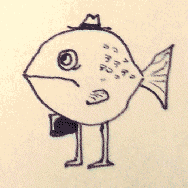
Everyone wants to harass sailors, Tommy Tunahead, it's not just you. Now sit back down, and tell me where the Mariana Trench is.In the end, though, I'll bet the ones that have it hardest at Merschool are the octopuses. They're so smart, but so weird-looking. And they can't help but show their feelings, they're totally unable to dissimulate what's going on because the chromatophores in their skin betray emotion. They're the biggest nerds of the ocean; they're that kid you see at lunch and say, "He's either going to be your boss, or your executioner."
Watch out for octopuses; and be nice to them.

Subscribe to:
Posts (Atom)